Where Do Vapes in Kenya Come From? Inside the Global Supply Chain
Where Do Kenya's Vaping Products Come From?

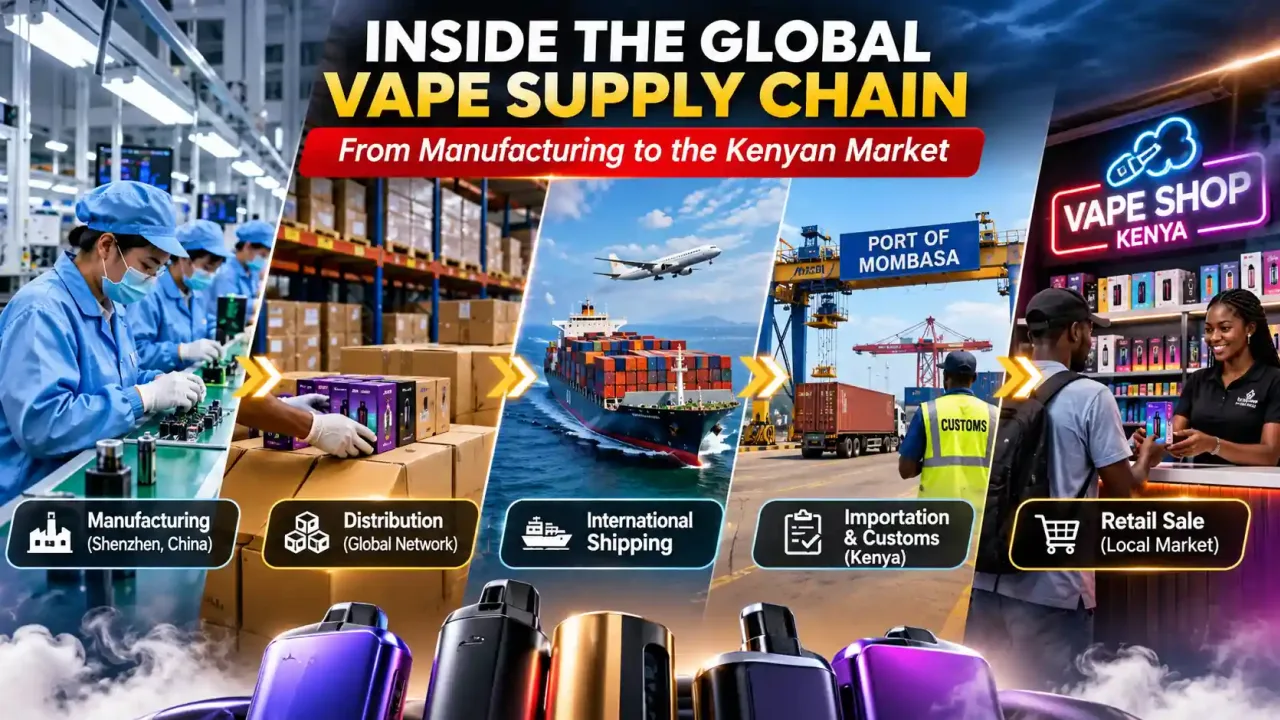
Have you ever wondered where the vaping devices sold in Kenya actually come from? Behind the familiar brand names, colourful packaging, superior quality and different device designs is an international manufacturing and distribution network involving component suppliers, electronics manufacturers, brand owners, exporters, importers and local vape shops.
Although consumers often associate a vaping product with the brand printed on its packaging, the company responsible for manufacturing the physical device may be an entirely different business. A product designed by one company, manufactured by another and distributed through several international markets can involve multiple organizations before reaching its final destination.
China plays a particularly significant role in this industry. Its manufacturing infrastructure, electronics supply networks and specialized production facilities have made it a central hub for global vape manufacturing.
For Kenya, understanding this international supply chain provides useful insight into product origins, brand ownership, distribution arrangements, import documentation and the factors that influence retail prices.
This article examines how the global vape industry operates, where many vaping products are manufactured and how international supply networks connect to the East African market.
1. Where Are Most Vaping Products Manufactured?
China is the dominant manufacturing centre for the global electronic cigarette industry. In particular, the city of Shenzhen, located in Guangdong Province, has developed into a major hub for vaping technology and electronic device production.
Its importance is not accidental. Shenzhen already had an established electronics manufacturing ecosystem long before the international vape industry expanded.
The city has extensive networks of businesses specialising in:
- Electronic circuit boards and microchips.
- Lithium-ion batteries and charging components.
- Heating elements and mesh coils.
- Plastic moulding and device casings.
- Display screens and electronic controls.
- E-liquid production and packaging.
- Product assembly and quality testing.
Having these suppliers within a closely connected manufacturing environment makes it possible for companies to coordinate different stages of production.
A 2026 research study published in the journal Tobacco Control identifies China as the world's central e-cigarette manufacturing hub, estimating that the country produces more than 90% of electronic cigarettes sold globally.
The research also examines how Chinese manufacturers supply both their own brands and products marketed under international brand names.
This concentration of manufacturing capacity helps explain why products carrying different brand identities can originate from the same broad manufacturing region.
2. Why Shenzhen Became the Centre of Global Vape Manufacturing
Shenzhen's manufacturing advantage extends beyond the availability of factories.
The city has a highly developed electronics ecosystem that supports rapid product development, component sourcing and large-scale assembly.
A company developing a new vaping device may require several specialised components, including a battery, heating element, electronic control system, charging interface and external casing.
In Shenzhen, many of these components can be sourced through established supplier networks.
This creates several manufacturing advantages:
Component availability: Manufacturers can access specialised electronic components without building every part of a device themselves.
Production integration: Different suppliers can coordinate manufacturing and assembly within a relatively concentrated industrial environment.
Product development: Established electronics infrastructure supports the development of new device designs and technical configurations.
Manufacturing scale: Large production facilities can manufacture devices for different brands and international markets.
Export infrastructure: Shenzhen's position within the Pearl River Delta provides access to major logistics and international shipping networks.
The result is a manufacturing environment capable of producing a wide range of vaping devices for different international markets.
3. Does the Brand on a Vape Box Actually Manufacture the Device?
One of the most interesting aspects of the global vape industry is the distinction between a brand owner and a manufacturer.
Consumers often assume that the company whose name appears on a product package is responsible for manufacturing every component. In reality, several business arrangements exist within international electronics manufacturing.
Two commonly used arrangements are Original Equipment Manufacturing (OEM) and Original Design Manufacturing (ODM).
Original Equipment Manufacturing (OEM)
Under an OEM arrangement, a manufacturer produces a device according to specifications, designs or requirements supplied by another company.
The brand owner may determine the product's appearance, technical requirements, packaging and other characteristics, while the manufacturing company handles production.
This arrangement allows companies to establish branded product ranges without necessarily operating their own factories.
Original Design Manufacturing (ODM)
ODM arrangements involve manufacturers that develop and produce devices using their own existing designs or technical platforms.
A separate brand owner may then market products developed through that manufacturing relationship under its own brand identity, subject to the relevant contractual arrangements.
The distinction matters because the manufacturer, product designer, brand owner and distributor may be separate organisations.
Consequently, identifying the company responsible for a product requires looking beyond the name printed on its packaging.
Why This Matters to Consumers
Understanding the difference between manufacturers and brand owners helps explain why two products can share similar internal technology while carrying different external designs and brand identities.
It also highlights why product authenticity should be checked through the relevant brand owner's official verification channels rather than assuming that the factory name alone establishes whether a product is genuine.
4. How International Vape Brands Fit Into the Manufacturing Network
The global vape market contains several different types of companies.
Some businesses focus primarily on developing and marketing their own brands. Others specialise in manufacturing electronic vaping devices for international customers. Some operate across both areas.
For example, internationally recognised names such as Elf Bar, Lost Mary, Al Fakher, AAOK Vapes, Voopoo, Vaporesso, SMOK and Uwell operate within a global industry where product development, manufacturing, branding and distribution can involve different corporate entities.
These businesses should not automatically be assumed to share the same ownership or manufacturing arrangements.
A useful way to understand the industry is to separate its main participants:
Brand owners: Businesses responsible for establishing product identities, brand standards and commercial positioning.
Device manufacturers: Companies that produce vaping hardware, including electronic components and assembled devices.
Component suppliers: Businesses supplying batteries, coils, chips, casings and other device components.
E-liquid manufacturers: Companies involved in producing and supplying liquids used in vaping devices.
International distributors: Businesses responsible for supplying products across different geographical markets.
Retailers: Businesses that operate at the final point of the distribution chain.
This structure explains why a product's brand, manufacturing location and country of distribution are not necessarily the same.
5. How Vaping Products Travel From Manufacturers to International Markets
Once a vaping product has been manufactured, it may enter an international distribution network before reaching retailers.
The general supply chain can be understood through several stages.
Stage 1: Manufacturing and Assembly
The manufacturer produces the device and coordinates the assembly of its individual components.
Depending on the manufacturing arrangement, this may involve several specialised suppliers.
Stage 2: Brand Ownership and Product Distribution
The finished product is associated with a particular brand and prepared for distribution through the brand owner's commercial network.
Products may be supplied through appointed distributors, regional partners or other documented commercial arrangements.
Stage 3: International Logistics
Products intended for international markets enter cross-border logistics networks.
Depending on the commercial arrangement, transportation may involve sea freight, air freight, warehousing and international freight-forwarding companies.
Stage 4: Importation and Customs Processing
When products reach their destination country, their importation becomes subject to that country's customs, tax, product-control and other applicable legal requirements.
Documentation, product classification, country of origin and applicable regulatory approvals are important considerations.
Stage 5: Domestic Distribution
Where importation and distribution are legally permitted, products may move through local distributors and wholesale networks before reaching retailers.
Stage 6: Retail
Retailers represent the final commercial point in the supply chain, where consumers encounter the finished products.
This structure is not exclusive to vaping. Similar arrangements exist throughout the international electronics and consumer-goods industries.
6. How Do Vaping Products Reach the Kenyan Market?
Kenya is connected to international consumer-goods supply chains through its ports, customs infrastructure and regional distribution networks.
For imported products generally, the Port of Mombasa is an important entry point for international merchandise entering Kenya and other East African markets.
However, understanding how a product physically enters a country is different from establishing whether its importation, distribution or sale is legally permitted.
Kenya has introduced significant regulatory measures affecting electronic cigarettes and other nicotine products.
In May 2025, the Ministry of Health announced the suspension of existing licences and import clearances relating to the manufacture, importation, distribution, sale and promotion of nicotine and related products, requiring previously licensed entities to reapply with compliance documentation.
Subsequent government communications have continued to highlight enforcement against illicit nicotine products and electronic cigarettes.
The Tobacco Control (Amendment) Bill, 2024, which includes provisions concerning electronic nicotine delivery systems, was also undergoing parliamentary consideration in 2026.
These developments are important when examining the Kenyan market because an international manufacturer's ability to export a product does not automatically establish that the product can legally be imported or sold in a country.
7. Product Origin, Customs Documentation and Supply-Chain Traceability
Another important aspect of international trade is the ability to establish where imported merchandise originates.
Country of origin is not necessarily the same as the country from which a product was shipped.
For example, a device manufactured in China could be distributed through a regional trading company before reaching another international market.
The country of shipment may therefore differ from the country of manufacture.
For businesses and consumers researching product authenticity, it is useful to distinguish between several different forms of verification:
- Country-of-origin documentation: Helps establish the declared origin of imported goods.
- Supplier documentation: Provides information about the commercial parties involved in the supply chain.
- Manufacturer authentication: Helps establish whether an individual product is recognised by the brand owner's verification system.
- Customs documentation: Relates to the declaration and processing of goods under applicable import requirements.
- Regulatory approvals: Establish whether the relevant products and activities satisfy applicable national requirements.
These processes serve different purposes. A product passing one verification process does not automatically satisfy every other requirement.
8. Why International Supply Chains Influence Retail Prices in Africa
The price of a finished vaping device is influenced by considerably more than its manufacturing cost.
By the time an imported electronic product reaches a retail market, several expenses and commercial considerations may have contributed to its final price.
These can include:
Manufacturing costs: Components, assembly, quality control, packaging and production overheads.
International transportation: Freight charges, cargo insurance, handling and associated logistics expenses.
Currency exchange: Changes in exchange rates can affect the cost of international purchases when transactions involve foreign currencies.
Customs and applicable taxes: Import-related duties, taxes and other charges can influence the landed cost of merchandise, where importation is legally permitted.
Distribution costs: Warehousing, handling, domestic transportation and distributor margins.
Retail operating expenses: Premises, staffing, administration, technology and other business costs.
Regulatory compliance: Applicable testing, documentation, certification and approval requirements can also influence operating expenses.
These factors help explain why the same internationally manufactured electronic product may have different retail prices across geographical markets.
A product's final price is therefore influenced by the entire supply chain rather than manufacturing costs alone.
It is also important to recognise that the presence of taxes or customs classifications does not, by itself, establish that a particular product is authorised for importation or sale.
9. Why Supply-Chain Transparency Matters in the Global Vape Industry
As the international vape market has expanded, supply-chain transparency has become an increasingly important subject.
Consumers, manufacturers, regulators and businesses all have an interest in understanding where products originate and which organizations are responsible for their production and distribution.
Several issues make transparency particularly relevant.
Brand ownership: Consumers may not always know which legal entity owns or controls a particular brand.
Contract manufacturing: A brand owner may rely on third-party factories to manufacture its devices.
International distribution: Products may pass through several commercial entities before reaching their final destination.
Counterfeit merchandise: Unauthorised manufacturers may reproduce familiar branding and packaging.
Regulatory differences: Products manufactured for one country may not satisfy the requirements of another market.
Product traceability: Documentation and authentication systems can help establish the identity and declared origin of merchandise.
A transparent supply chain makes it easier to distinguish legitimate manufacturing relationships from unauthorised production and distribution.
However, no single document or authentication code provides a complete picture of a product's legal status, manufacturing history and safety.